Your traffic is flat or slipping, even though you still rank fine on Google. That’s not a fluke — the game changed underneath you. Google’s AI Overviews now answer roughly 15% of all searches, climbing to nearly 30% of informational ones, and if your site isn’t cited inside that answer, you’re invisible before the reader even sees the blue links. This AI search visibility checklist for small business websites walks through exactly what to fix, starting today.
Why your rankings don’t matter the way they used to
For years, “rank on page one” was the whole game. Now Google often answers the question directly at the top of the page, before any list of links appears. That AI-generated answer box — an AI Overview — shows up on about 15% of all searches and nearly 30% of informational queries, according to BrightEdge data reported by Forbes in May 2026.
Here’s the part that actually hurts: sites quoted inside an AI Overview pull in 35% more organic clicks than the ones left out of it, on the very same results page. So ranking #3 with no citation can now lose to ranking #7 with one. If your site isn’t structured in a way AI engines can read and quote, you’re doing all the SEO work and handing the reward to a competitor who isn’t even outranking you.
This is why “why is my website traffic dropping even though I rank well” has become such a common question. The answer usually isn’t your rankings — it’s your visibility inside the AI layer sitting on top of them.
What is answer engine optimization (AEO)?
Answer engine optimization (AEO) means structuring your site so AI tools like Google’s AI Overviews and ChatGPT can easily find, understand, and quote your content as the answer. Most articles on this topic stop right here, at the definition, and never tell you what to actually do about it. We’re not doing that — the rest of this post is the checklist.
The AI visibility problem hiding in most South African small business sites
A 2026 audit of more than 50 South African SME websites found the same gaps showing up again and again:
| Issue | Share of sites affected |
|---|---|
| No author schema | Over 80% |
| Duplicate structured data | Over 70% |
| Content written for AI visibility | Under 10% |
If you haven’t touched any of this, you’re in the majority, not the exception. That’s actually good news — fixing even one of these puts you ahead of most competitors in your space.
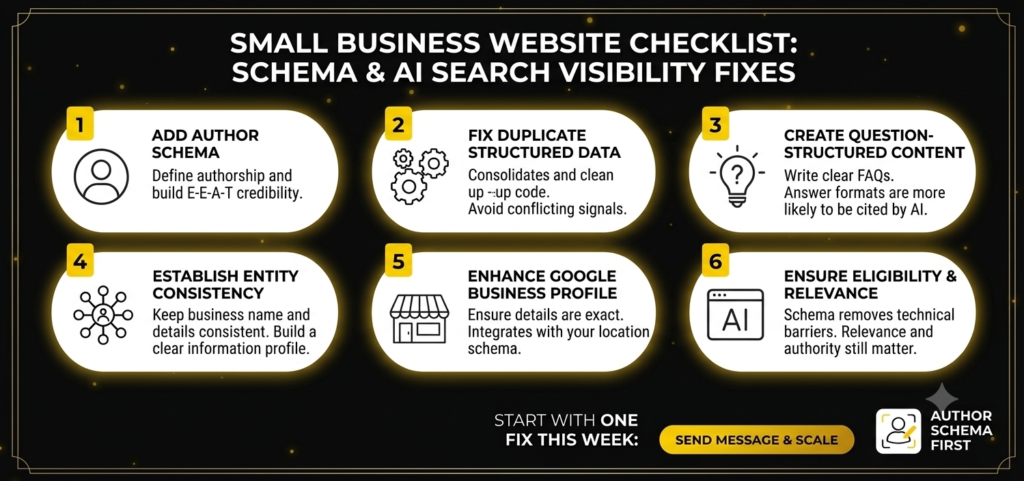
The AI search visibility checklist for small business websites
This is the actual checklist — the fixes behind those numbers above, in order of impact.
1. Add author and business schema
Schema markup is a small piece of code that tells search engines and AI tools exactly what your content is and who wrote it — instead of making them guess. Author schema identifies the person behind an article; business schema (LocalBusiness or Organization type) identifies your company, its location, and what it does.
Over 80% of audited SA small business sites are missing author schema entirely, which is the single biggest gap found. If you’re on WordPress, plugins like Yoast SEO or Rank Math can add both types with a few form fields — no coding required.
2. Find and fix duplicate structured data
Duplicate schema happens more often than you’d think — usually when your theme injects one version of business schema and an SEO plugin adds a second, conflicting one. AI engines and search engines can get confused by contradictory signals and simply ignore both.
Check your site with Google’s Rich Results Test or the structured data report in Search Console. If you spot duplicates, turn off schema generation in one tool (usually the theme) and let your SEO plugin handle it alone.
3. Write content structured around real customer questions
People increasingly search in full questions — “how much does a logo redesign cost,” not “logo redesign pricing” — especially through voice search and chat-style AI tools. Structure your content the same way: use H2 headings phrased as real questions, followed by a short, direct answer in the first sentence or two.
This format is exactly what AI engines lift and quote. Save the detail and nuance for the paragraphs after that first direct answer.
4. Keep business/entity info clearly and consistently stated
AI tools cross-check your name, address, and phone number (NAP) across your website, directories, and social profiles before trusting your business as a real, verifiable entity. Inconsistent details — a different phone number on your contact page than on Google — create doubt that can quietly knock you out of consideration.
Make sure your About page states clearly who you are and what you do, and that this matches your Google Business Profile exactly. That consistency is the bridge into the next section.
Bridge it to Google Business Profile — and to your city, if that’s relevant
Google Business Profile (GBP) isn’t a separate task from the checklist above — it’s an extension of fix #4. AI engines lean heavily on GBP as a trust signal, since it’s a verified, structured source of your business’s name, address, hours, and category. Keeping it aligned with your website’s schema reinforces the same entity signal from two directions at once.
If you’re an agency owner auditing client sites in Johannesburg or Cape Town, this is often the fastest win you can point to — a GBP mismatch is quick to spot and quick to fix, and it makes an immediate, visible difference. Beyond this one bridge, though, keep city names out of the rest of the checklist. The core fixes — schema, entity clarity, question-structured content — apply the same way nationwide.
Should agencies offer AI visibility audits as a service?
Yes. Almost none of your competitors’ client sites have this work done, based on the SA audit data above, which means it’s a genuinely open gap rather than a crowded pitch. It’s also a checklist-sized offer, not a rebuild — you’re adding schema, tidying entity info, and restructuring existing content, not redesigning a site from scratch.
That makes it a natural add-on to SEO or Google Business Profile retainers you’re already running, rather than a new sales conversation from zero. Frame it as “the AI-visibility layer on top of the SEO work we’re already doing for you,” and most clients will see the logic immediately.
FAQ
Does fixing schema markup guarantee my site shows up in AI Overviews? No. Schema and structured content make you eligible to be cited — they remove the technical barriers stopping AI engines from understanding your site. Whether you actually get cited still depends on relevance, authority, and competition for that specific query.
Do I need to redo my SEO if I do this AI-visibility work instead? No — this builds on your existing SEO, it doesn’t replace it. Rankings still matter; AI visibility is the next layer on top, not a substitute for solid on-page and technical SEO.
How long does it take to see a difference after adding schema? It varies, but most sites see search engines and AI tools pick up schema changes within a few weeks, since it depends on how often your pages get crawled. Content and entity changes can take a little longer to show up in AI-generated answers.
Can I do this myself, or do I need a developer? Most of this checklist is doable yourself if you’re on WordPress with a plugin like Yoast or Rank Math — schema and business info are usually simple form fields. A developer is only really needed if you’re on a custom-built site without plugin support.
Start with one fix this week
This AI search visibility checklist for small business websites isn’t a replacement for your SEO or Google Business Profile work — it’s the next layer on top of it. If you only do one thing this week, add author schema first, since it’s the single biggest gap the SA audit found and one of the fastest to fix. Once that’s in place, work through duplicate structured data, question-structured content, and entity consistency in turn.
If you’d rather have someone check all of this for you, Zaki SMMA’s SEO and Google Business Profile services include an AI-visibility audit as part of the process, so you’re not stuck reading a checklist and hoping you did it right.