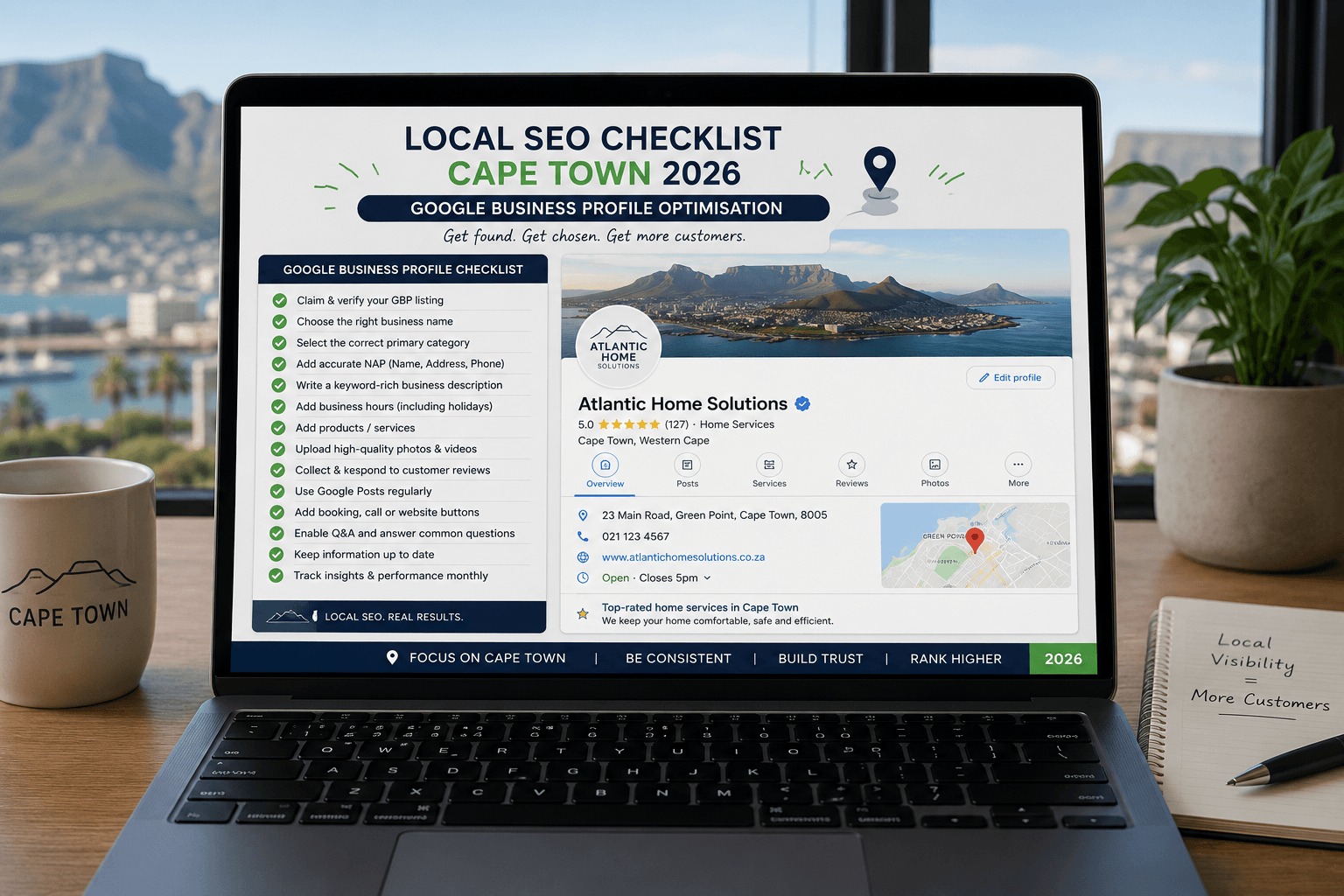
You’ve already got a Google Business Profile. You’ve filled in the hours, the categories, the photos. Good — this isn’t a “here’s how to set up your listing” post. If that’s what you need, that’s a different article.
This is the local SEO checklist Cape Town 2026 businesses actually need once the basics are done: a ranked list of what to do first, what’s worth doing but won’t move the needle overnight, and what to quietly stop wasting time on. Not alphabetical, not “10 tips” filler — ranked by actual impact, based on what’s changed this year.
Here’s why that ranking matters. Mobile makes up more than 60% of local search traffic in Cape Town, and for most service and retail searches, showing up in the local pack beats sitting at #1 in the plain organic results below it. If you’re only doing the things that used to work, you’re leaving that visibility on the table.
Why This Local SEO Checklist for Cape Town 2026 Is Ranked, Not Alphabetical
Industry surveys of local ranking factors consistently put proximity to the searcher as the single biggest piece of the puzzle — and it’s the one thing you can’t control. No amount of optimization moves a customer closer to your shop.
What you can control still matters a lot, just in a different order than a few years ago. Your Google Business Profile activity and review signals now carry more weight than they used to, on-page and website SEO remains a solid chunk of the equation, and link and citation signals matter less than they once did. Social signals and AI search behavior are also starting to factor into local visibility in ways they simply didn’t before.
The framing to carry through the rest of this checklist: local visibility in 2026 is built on engagement, credibility, and connection — not on having a “complete” listing or stuffing your profile with keywords. That’s table stakes now, not a differentiator. Here’s what actually moves the needle, starting with the highest-impact stuff.
Tier 1 — Do These First (Highest-Impact, Controllable in 2026)
Run Your GBP Like a Weekly Channel, Not a Listing You Set Once
Post 2-3 times a week. Add fresh photos regularly. Check your Q&A section and answer anything sitting there unanswered.
Here’s the nuance most people miss: GBP posts aren’t a direct ranking signal. What they do is lift your click-through rate and take up visual real estate that a competitor’s listing would otherwise occupy. They also feed the freshness signal that AI-generated summaries pull from when answering local search queries.
Why this matters right now — businesses that treat their GBP as a live, active channel are reporting a noticeable lift in calls, direction requests, website visits, and bookings compared to profiles that just sit there untouched. That’s not a small difference. Businesses treating their profile as a live channel are capturing a real, measurable increase in action-taking customers.
One reminder before you move on: a fully completed profile still consistently earns several times more clicks than an incomplete one. But that’s the floor, not the ceiling. Completeness gets you in the game — it doesn’t win it.
Build Real Review Velocity and Recency
Recency and velocity beat raw star rating or total review count. A business with 15 reviews from the last two months will often outrank one sitting on 80 reviews that stopped coming in a year ago.
For Cape Town, aim for 4+ new reviews a month as a working benchmark. We’ve seen businesses move from under 20 total reviews to 50+ recent ones and watch their local pack position improve in genuinely competitive categories — the kind where five businesses are all a five-minute drive from the same searcher.
Respond to every review, not just the negative ones. If you’ve got a backlog of unanswered reviews sitting there, clear it. GBP now offers AI-drafted review replies that you review and edit before publishing — genuinely useful for chewing through that backlog fast. Just don’t auto-post a generic AI reply on a 1- or 2-star review. That’s the one place a human response actually matters.
Audit Your Profile for Integrity Risk Before Google Does It For You
Google has been tightening how it verifies review authenticity, and reports from local SEO practitioners suggest the checks now go well beyond scanning review text — looking at where and when a review was written, the reviewer’s activity pattern, and whether their location is plausible given their review history. Bought reviews and review-gating are riskier now than they’ve ever been.
Run a quick audit on your own listing:
- No keyword-stuffed business name (more on why this is now actively dangerous, not just tacky, in Tier 3)
- Real photos — no stock images pretending to be your storefront or team
- Accurate category and service-area setup that actually matches what you do
This isn’t just about ranking lower if you get this wrong. Google has shown it’s willing to flag and suspend non-compliant listings in 2026. A suspended profile means zero visibility, not reduced visibility.
Confirm Verification Under the New Video Requirement
Google has been rolling out video-walkthrough verification for small businesses in 2026, replacing the old postcard-by-mail process in more and more cases.
Action item: check your verification status now, even if you verified years ago. If anything about your listing has changed since then — address, ownership, category — don’t assume you’re grandfathered in and unaffected.
Tier 2 — Worth Doing, Secondary Impact
Get NAP Consistent Everywhere — Then Stop Chasing Volume
Your name, address, and phone number need to match exactly across your website, your social profiles, and the directories that matter. That part hasn’t changed.
What has changed is the citation-building playbook. Quality now outweighs quantity — a mention on a relevant “best of Cape Town” industry list does more for you than another 30 generic directory submissions. Get your NAP consistent, then stop treating citation volume as a growth lever. It isn’t one anymore.
Handle the On-Page and Technical Side of SEO
This is the half of local SEO that has nothing to do with your GBP listing — location-specific service pages, schema markup, page speed, and a mobile experience that doesn’t make someone give up and call a competitor instead.
Think of this as the part of the checklist that compounds over months rather than something you fix once and forget. It’s ongoing work, not a task you tick off. If you’d rather not manage the technical and on-page side of SEO yourself, this is exactly the kind of thing is built to handle on an ongoing basis — it’s not a one-time fix, so it’s not really a DIY checklist item the way a GBP post is.
Make Your Reviews “AI-Referenceable”
Here’s why the actual content of a review matters more than it used to. AI Overviews are increasingly answering local-intent searches directly from GBP data and review content — before the searcher ever clicks through to a website. Industry click-through studies show organic CTR dropping noticeably when an AI Overview appears on a search result page, compared to results pages without one.
That means a five-star rating with no text is doing less work for you than it used to. Encourage customers to mention the specific service they used, the suburb they’re in, and the result they got — not just “great service, five stars.” That kind of detail is exactly what an AI Overview or a customer scanning your reviews needs to make a decision.
Go Deep on Your Actual Suburb, Not Wide Across All of Cape Town
If you’re a single-location business, suburb-level relevance beats trying to rank across the entire city. A coffee shop in Sea Point competing to be found by people specifically in Sea Point will out-rank one trying to look relevant to all of Cape Town at once. The same goes for a service business based in Claremont or Woodstock — and if you’re a service-area business covering somewhere like Century City, Bellville, or Table View, your GBP service-area setup should reflect that specifically rather than a vague “Cape Town” catch-all.
On timeline — don’t expect this to move overnight. Most Cape Town categories show measurable movement around month 3-5. Competitive verticals like property and medical practices are closer to 6 months before you see real shifts. That’s not a reason to skip the work; it’s a reason not to panic in month one.
Tier 3 — Skip or Deprioritize in 2026 (What Used to Work, Doesn’t Anymore)
A few things worth actively stopping, not just deprioritizing:
- Mass low-quality citation submissions. Submitting your business to another 50 low-authority directories for volume’s sake doesn’t move rankings the way it did five years ago.
- Keyword-stuffed business names or GBP field-stuffing. This used to just be ineffective. Now it’s an active suspension risk — Google is actively looking for exactly this kind of manipulation.
- Posting on GBP with no engagement follow-through. Posting purely for the sake of posting, with nobody responding to comments or questions, doesn’t move rank on its own. Posts help when they’re part of a live, responsive profile — not a checkbox exercise.
- Treating GBP completeness as “done.” A fully filled-out profile is where you start in 2026, not where you finish.
Frame this section as reallocation, not just a “don’t bother” list. Every hour you’re not spending on mass citations or GBP field-stuffing is an hour you can put into Tier 1 instead.
How Long Before You See Movement?
Worth restating plainly before we wrap up: most Cape Town categories start showing measurable local pack movement around month 3-5 of running this checklist consistently. More competitive categories — property, medical, and similar high-stakes verticals — tend to land closer to month 6. This is a ranked checklist built for compounding results, not an overnight-results play. Anyone promising you a page-one local pack spot in two weeks is selling you something.
If This Feels Like a Lot to Manage on Top of Running Your Business
It is a lot. Weekly GBP activity, a monthly review-gathering cadence, ongoing on-page SEO work that compounds over months — that’s a real, recurring time commitment on top of actually running your business.
If you’d rather someone else own this list end-to-end, that’s a reasonable call, not a shortcut. It’s exactly the kind of ongoing work handles for local businesses who’d rather spend their week serving customers than posting to GBP and chasing reviews.
If you’re an agency operator reading this instead of a business owner, this checklist doubles as a ready-made audit framework — run it against a prospect’s listing, and the gaps become your pitch. If you’re a business owner, you can run it yourself starting today, or hand the whole thing off. Either way, the list doesn’t change — just who’s holding it.